
Anyone have a suggestion(s) of why my numbers would be reduced since midnight? There have been no changes in hardware (Pi, Ant, Dongle, etc). Everything prior to midnight the messages and aircraft numbers were double what they are today. Dongle amp failure?
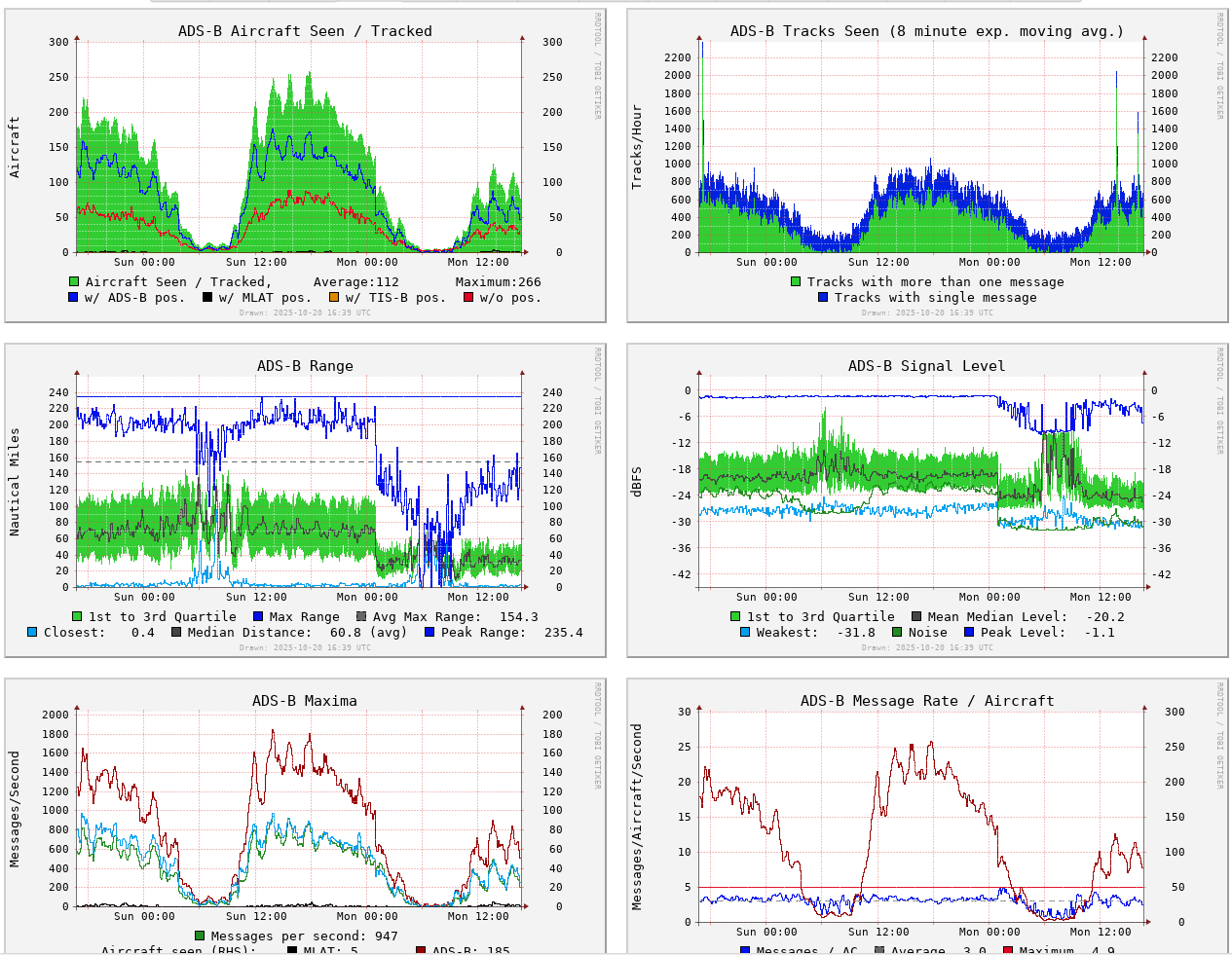
What did you have for weather overnight? Rain possibly? Water intrusion in the coax connections will cause such an effect.
Great question. We did not have rain, have not had any on nearly 3 weeks. We did have some wind. I will check connections just to be sure.
978 which is different ant, coax and dongle

I’d try disconnecting and reconnecting all the RF connectors you can reach.
Testing the PSU would be my next step.
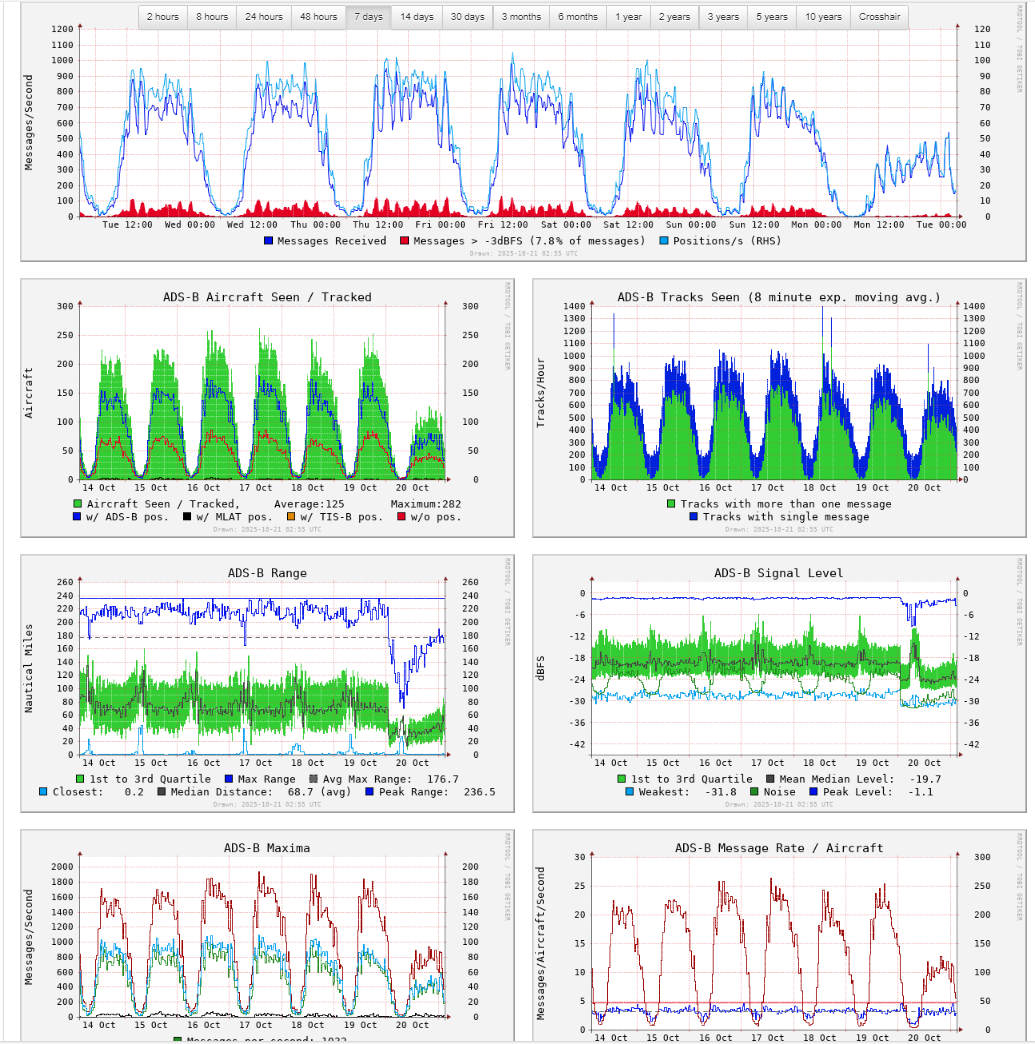
I will be doing this later today. You can see below this is poor performance even compared to past before better ant and coax.

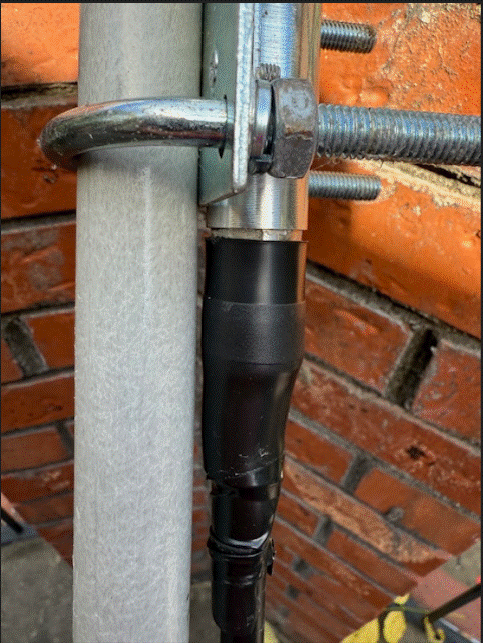
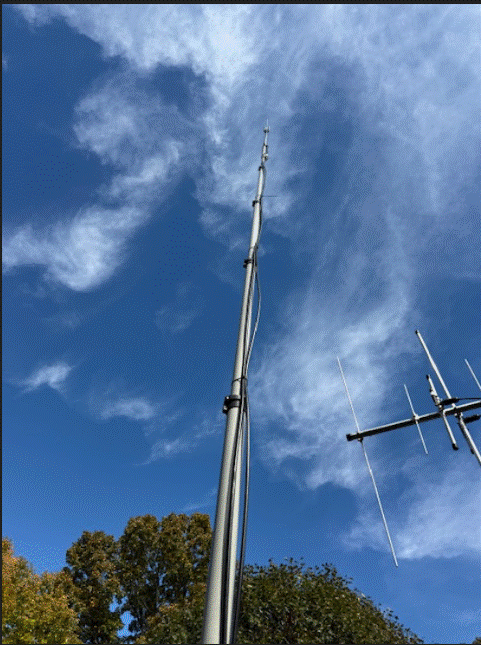
Thanks everyone for the replies. Based on suggestions I did an inspection of the antenna and coax of which both are only a couple of weeks old. I checked for water and any other encroachment and found none. I checked the antenna itself and then the coax (LMR400) at both ends. At the dongle end I found it was not as tight as it should have been. When I dropped the DX Engineering Fiberglass Tubing and inspected the antenna and found that possibly the strong winds we had may have caused the coax N-Male to turn slightly. I have a boot around the N-Male and turned the N-Male tighter onto the antenna. I believe it turned no more than a quarter turn. Afterwards I raised the tubing and strapped the coax with cable ties. Below are photos of it when complete.

Below shows I am now back to what I was expecting to see.

5 Likes
Nice to see that you are back in the game. A quarter turn of loose is enough to create a signal problem. I have found that “hand tight” on coax connections is never enough over the long run. Mechanical tightening with pliers and or wrenches is the proven secure connection technique. I may well be stating what you already know but it’s hard to tell what people may already know. You must be very careful to not overtighten tie wraps when using them to secure coax cable. Deforming the outer circumference of the coax can influence the signal. I avoid any physical restraint of the coax by rotating the antenna mast as I raise the mast such that the coax wraps itself around the mast as you rotate and raise the mast pipe. The coax conforms nicely to the mast and becomes even more secure in winds because of the twist rate around the mast.
Thanks for the feedback.
1 Like
Considering my estimate of how much that enclosure costs, i see an sawbird ADS-B + airspy mini in your future 
No guarantees but as you can probably read on some other threads on this forum, it has increased the reception for quite a few stations.
One upside even if the range isn’t increased, the higher dynamic range will allow getting both very close by planes and planes at max range.
It needs some software changes, if you don’t want to deal with the command line, there is adsb.im as a premade image that will support the airspy mini without command line changes needed.
Looking at the components inside the enclosure, I would suggest creating some physical isolation between the receiver dongle and what appears to be the USB power source. USB power generation can create noise that degrades the performance of the receiver. Maybe the receiver moves up on to the shelf above or the USB power moves and becomes a distant neighbor.
I assume you are referring to the “Nooelec SAWbird+ ADS-B: Premium, Dual-Channel, Cascaded Ultra-Low Noise Amplifier (LNA) & Filter Module for Airplane Tracking Applications. 1090MHz (ADSB) and 978MHz (UAT) Center Frequencies” as found on Amazon. If not, can you share?
If I take the two antennas I have now and feed to the input of this device and the dongles on the backside, that may get some improvement in one form or another.
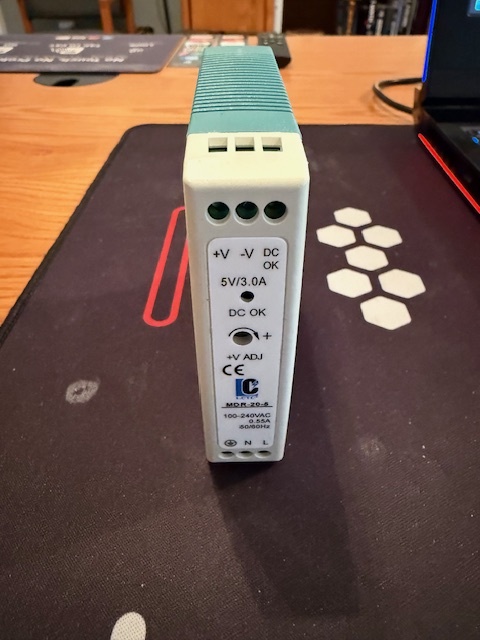
As part of my next project I am moving the Pi 4 to a DIN and adding a DIN PS. The Pi 4 will have cooling and a PiSugar battery backup. The battery as seen in the picture would have fit under the Pi but the mounting screws to the DIN carrier are causing me to try something else to deal with the battery.
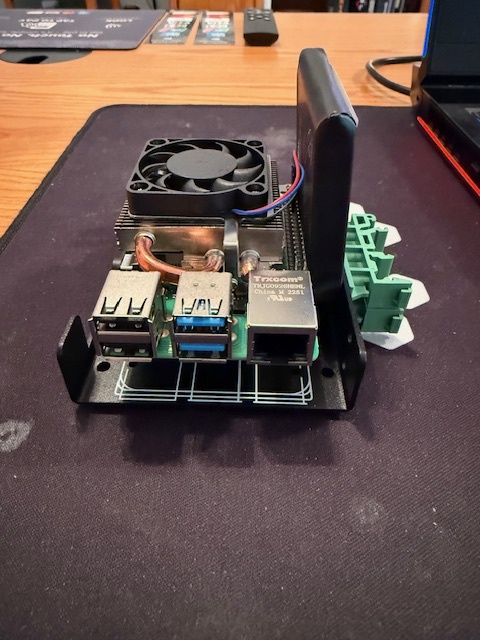
The PS as seen below is what I plan to support this new infrastructure. I do have long USB to USB cables so I will be able to separate the dongles. And the PS will be above with Pi and not below with dongles.
2 Likes
I never use tiewraps on a setup, I always secure things with velcro straps since they can’t deform the cables. That’s a practice I’ve picked up while working in datacenters. The same applies to high speed data cables, both Ethernet and Fiberoptics. Tiewraps are also under influence of UV degradation when used outside and can be breaking within a few months, also circumvented by the use of the Velcrostraps.
1 Like
Correct you are sir. Time spent in both data networking and the cable tv industry reinforces those practices.
Thanks, I have straps and will swap out when I do my next upgrade next week.
Well into the current SDRs that might be too much amplification.
I was recommending it specifically for 1090 with the airspy mini because it doesn’t have a builtin LNA like your current 1090 SDR.
Dosmond. Wanted to share with you what my antenna mast and it’s spiraling 400 coax looks like in practice.

2 Likes
I understand the wrap approach which I do on my other pole portions. But what do you do on the tower itself? Do you actually wrap it too?
The coax wrap ends at the bottom of the mast where it transitions to the apex tower section. It transitions from there to the house entrance where it enters my study and connects to a “Lothar of the Hill People” filter; a blue FA dongle and over to the RPi 4B+.
