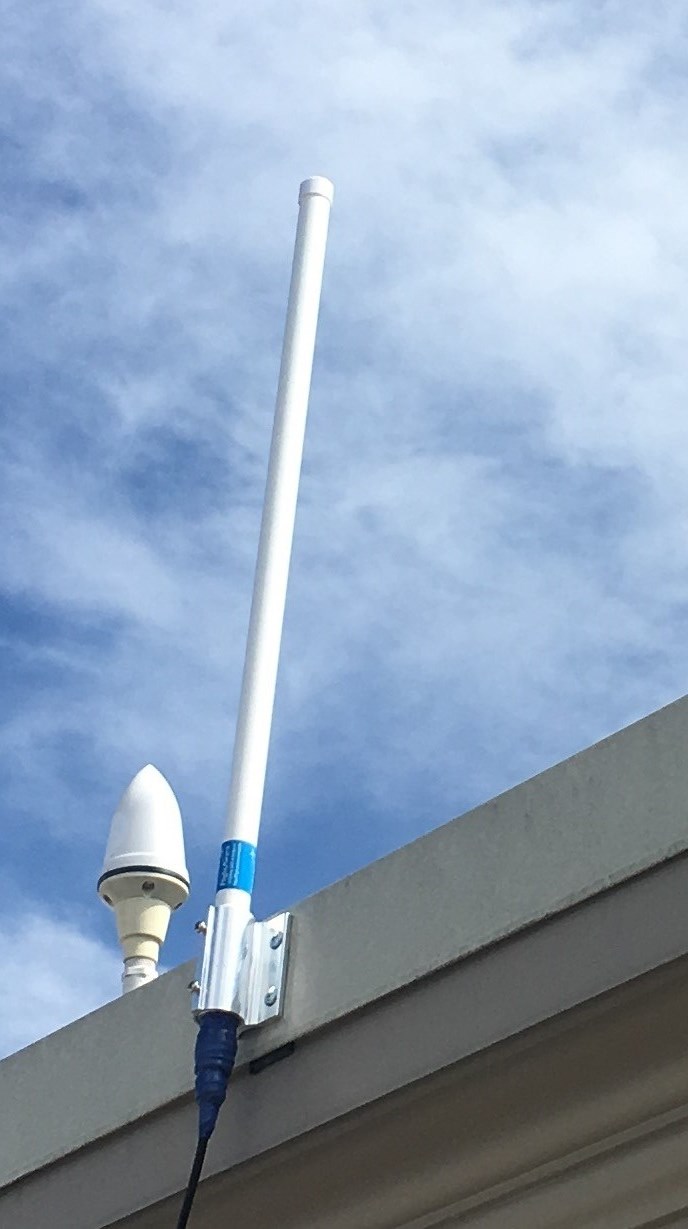
great point that I didn’t think of when imagining putting the 978 antenna on the mast below the 1090 one.
Rethinking things, it won’t mean as much in my situation, though, as I have 225 nautical mile range to the north, south, and west but only about 50 miles to the east due to living 1 mile from a 9000 foot mountain in the southern rockies.
I think I’ll be mounting my 978 antenna to the west side of the pole to give me full north, south, west coverage and have mast blockage on some of the east coverage because of its much shorter range.
If I had 225 nautical mile range in all directions, I definitely would be following your recommendation and building an offset mounting bracket to minimize the amount of blockage due to the mast.
If you want optimal reception even in the direction away from the mast (viewed from the antenna), the antenna shouldn’t be too close to the mast.
Some internet reading suggest lambda/4 as an absolute minimum.
That’s around 7 cm or a little less than 3 inches.
So i would still recommend such an offset.
But it might not be important because the typical ranges of UAT aircraft basically mean the signal is strong enough if the airplane is in LOS.
I don’t think 1/4wave would be a good choice.
The mast will act as a reflector (a bit like the rear element in a yagi),
The additional path length of an incoming wave, passing the antenna and reflecting off the mast will be lambda/2 (otherwise known as 180degree phase shift).
This is exactly the correct dimension if you want to cancel the incoming signal.
I’ve built a double offset mount (one antenna each side of the mast) with a 1.2m span (or 2x 600mm offset). This may be excessive (for 1090MHz), but I’d still like to see at least one wavelength separation.
300mm is not very much material after all.
The horizontal distance between antennas should be greater than 1/4 of its wavelength (absolute minimum separation), but it should not be located at the exact multiples of its wavelength (maybe avoid the first 3-4 multiples). If multiple frequency antennas are near each other, then use the spacing distance of the lower frequency antenna, or even better try to satisfy the rule for both frequencies.
Since 978MHz has a wavelength of about 12.073 inches, this means that the horizontal spacing should be greater than 3 inches, but not 12.07" (1x), 24.15" (2x), 36.22" (3x), etc., correct?
Depending on where the signal comes from the travel distance will be different, which means depending on direction you have constructive or destructive interference.
I don’t think spacing larger than 10 inches will improve things much.
I’d just go with the hardware you can get.
Those are not really meaningful points of comparison.
The cell phone antennas don’t point at each other and they Tx/Rx on different frequencies.
You can bet the person who designed your cell phone antenna didn’t learn his (her) trade from a couple of blog sites and has better diagnostic equipment than a $10 computer accessory.
Back to the point - mounting a receiving antenna “too close” to a mast (or other reflector) won’t damage anything. It’ll just give you a null in some directions. It’ll probably still perform better than an indoor antenna.
But only from one direction the antennas will be aligned one behind the other. If the signal comes from other direction, it won’t reflect “around the corner”, in an angle. 1GHz radio behaves a lot like light, goes in straight line, not to much refraction.
It will affect the antenna capacitance to the ground and will take it out of tune and also “bleed” some of that received signal to the ground.
All the antenna models implies that the Earth is located in a certain spot.
You have completely misunderstood the issue.
My statements did NOT put any doubts on the qualification or knowledge of cell phone designers, or the quality of design of cell phones. I fully understand that cell phones are very well designed by highly qualified and experienced designers.
I simply asked “How much is the spacing between transmitting & receiving antennas of cell phones?”
I expected an answer in mm or fraction of wavelength.
Regarding metal masts and reflectors.
Damage? No.
Change patterns? Yes, very much so, and pattern is what ‘enables’ gain, directivity, nulling, F/B ratio, etc.
The size of this phone is 65mm x 145mm
It operates on many cell bands including LTE-U 5Ghz, GSM 800 & GSM 950. The last two are very close to 1090 Mhz.
How many mm spacing of antennas a visual estimate gives you?
Thanks for the picture. While I always wondered how the phone could operate efficiently in so many different frequencies, I had no idea it actually had multiple antennas.
It confirms what I wrote above, separation/isolation is easily manageable at these frequencies.
Between Transmit and Receive, usually none at all. The same antenna is used for both Transmit and Receive.
Filters and circulators are used to provide the isolation between the transmit and receive paths.
The antennas are directional so multiple antennas are used to provide coverage in different directions.
Sorry, I understood both statements referred to base station antennas.
Yep, cell phones are just voodoo - they shouldn’t work!
Change: yes. But to the point of being worse than an indoor antenna? Maybe not. As a proof of concept, it’s worth getting the antenna up high, even if that means a crap mount.
Once ‘something’ has been proved, more effort can be spent doing a better mount or scrapping the antenna and starting again.
It is at the edge of a flat roof, about 3’ from the GPS antenna.
Performance looks good, VSWR of 1.3:1 measured at the end of a -1.4 dB cable @ 978 MHz .