
The last time I checked my generic R820T2 sticks they drew about 280mA. So this is a much more efficient design (or the spec is wrong :mrgreen: )
Would it be a reasonable approach to use the large FlightAware antenna, a filter, a splitter and two of these dongles to receive 978 and 1090 simultaneously?
This can work. The main thing to remember is the losses between the antenna and cables matter with the amplifier at the receiver.
Here are some numbers to make more sense what you will get if you do this.
The test setup is the small FA antenna to a RF cable into a FA filter to a FA prostick.
(losses between Antenna and prostick*) - (distance you will see a plane)
2.5dB - 210 NM (241 miles)
4.0dB - 196 NM (225 miles)
5.3dB- 177 NM (203 miles)
*This is including the 1.5dB losses from the FA filter
As long as you keep your losses low between your antenna and prostick you should see something similar. Splitter have a loss of about 3dB but the large FA antenna would counter most of the splitter loss.
If you are worried about the cable losses you can ask an manufacturer for the specs. They will give you a table based on 100 feet of cable at different frequencies. You want the losses at 1000Mhz ( 1 GHz).
Cheap coax cables are usually rated around 15dB/100 feet @ 1000Mhz. 1.5dB of cable loss per 10 feet.
CA240 or LMR240 (recommended cable) is rated at 7.7dB/100 feet @ 1000Mhz. 0.7dB of cable loss per 10 feet.
CA400 or LMR400 is rated at 3.8dB/100 feet @1000MHz. This would lower your cable loss to 0.38dB per 10 feet.
I know what it says…and I know what the NooElec dongles have always claimed - but that still hasn’t prevented countless people from complaining about power issues when attempting to run other power-hungry devices on another Pi USB port while running a dongle with the gain jacked-up. Based on that, I’m going to assume that trying to power an amp through a dongle is likely to cause problems. 
Besides, power inserters are just too easy.
Matt
–
Flightaware staff,
Is this a 50 ohm or 75 ohm receiver?
You’re welcome to believe whatever you wish, but keep in mind most “power issues” are not due to excessive draw from the dongle. Unless FA updates the power draw data, I’m going to assume it’s correct. Considering they are the authority on their product, I’m going to give them their due respect. At this time, no one else has this hardware.
In addition to what david.baker said: make sure you use a proper splitter with good isolation. The dongles tend to feed quite a bit of noise (local oscillator leakage etc) back to the antenna input.
[quote=“BartJr”]
The prostick current draw is 300mA.
The Nooelec one is 280mA and the FlightAware Pro Stick is 300mA. We’re updating the specs – not sure where 150 came from but it’s wrong.
All R820T2 radio chips are 75ohms. There is no way around this unless they redo that chip. The input for the prostick is 50ohms which is then fed into the amplifier which is then fed into the 75 ohm radio chip.
Just relaying what I’ve read over and over again on multiple sites for over a year now. To each his own.
Either way, it doesn’t pass power and my Mini-Circuits amp gets 12v and pulls around 465mA, so it wouldn’t work anyway.
Matt
–
Nifty! Convenient that my cheapo LNA bit the big one this week.
Question that was posed but not quite answered - **does this have a TXCO? Is there data on the frequency drift tolerances?
**
… I mean - I already ordered one, so I guess the proof will be in the pudding. Looking forward to comparing it to the RTL-SDR TXCO dongle currently installed.
What’s the frequency range of the dongle? 978-1090?
Thanks
Thanks for the data table!
If I understand correctly, the data was collected using the small - 5.5 dB gain - antenna?
How about mounting this dongle on the antenna just below the filter, instead of coax you can run an active USB, no coax losses. Will it fit inside the metal RTL-SDR case or is it a different profile?
Now if only someone had a cheap but yet good sma splitter on Amazon I would be all set after ordering one of these.
Yes. The small 5.5dB FA antenna.
It does not have a TXCO. I haven’t seen anything about frequency drift.
Reference: reddit.com/r/RTLSDR/comment … _adsb_and/
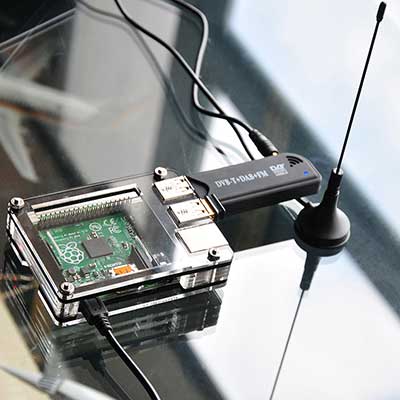
BTW just noticed the nice PhotoShop job. 
Thought something was off being the “Pro” in this picture has an MCX connector coming off the side.

Do you mean that the front end chip (RF Amplifier chip) has an input impedance of 50 ohms & output impedance of 75 ohms, feeding 75 ohms input of R820T2 Tuner chip?
Good eye jprochazka… I thought that photo meant it has both SMA and MCX connectors! I guess it’s SMA only then.
